Inventory basics
How to Create a Correct SKU
A Short Guide to SKUs
By Jacek Jarecki
Download PDFWhat is a SKU?
SKU (Stock Keeping Unit) is a unique alphanumeric code assigned by the seller to a product or specific listing in order to manage the catalogue and stock. It is the seller's internal identifier - not a global product number. On Amazon, you can create your own SKU or use one generated by the system.
SKU vs other identifiers
| EAN / GTIN | A global product identifier. It does not depend on the seller or marketplace. |
|---|---|
| ASIN | Amazon Standard Identification Number - a 10-character product identifier in the Amazon catalogue. Listings for the same catalogue product use the same ASIN. |
| SKU | Your code for a specific listing or stock item. One ASIN can have several SKUs for the same seller, for example separate SKUs for merchant-fulfilled and FBA offers. |
| FNSKU | Fulfillment Network Stock Keeping Unit - Amazon's identifier for FBA inventory associated with a specific seller. It helps distinguish that seller's units from inventory belonging to other sellers. |
01
Building a SKU: from broad to specific
The simplest system is usually the best: each part of the code should have one fixed meaning.
Base example
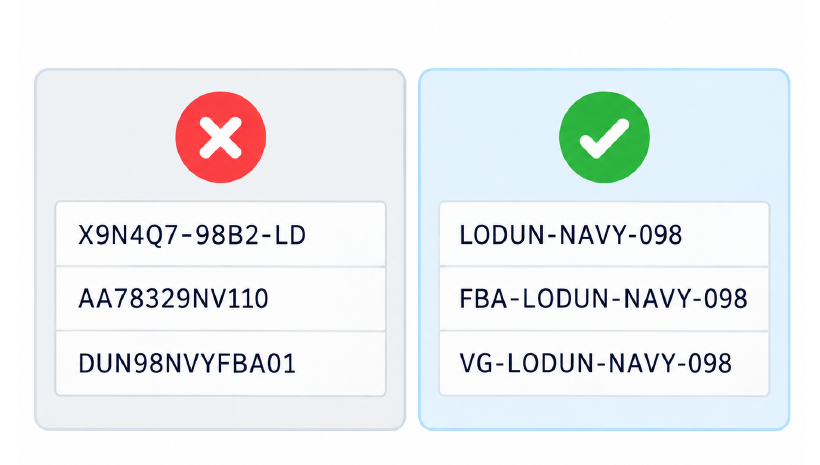
LODUN-NAVY-098
| LO | DUN | NAVY | 098 |
|---|---|---|---|
| BrandLOVRAIN | ProductDungarees | ColourNavy | Size98 cm |
Why this order?
The code starts with the broadest information and then moves towards the details. This naturally groups variants from the same product family together, while the SKU itself can be understood without opening the product page.
A short, fixed code. Example: LO = LOVRAIN.
Create one consistent code dictionary: DUN = dungarees, JAC = jacket, etc.
Colour or another attribute that you actually distinguish in the catalogue. Example: NAVY.
A value always written in the same format. Example: 098, 104, 110.
The separator is part of the system too
A hyphen greatly improves readability and works well across marketplaces, CSV files and Excel. The key is to use the same separator consistently throughout the catalogue.
02
Sorting: a small detail that makes a big difference
Why?
In many reports, spreadsheets and systems, a SKU is treated as text. This means the software compares characters from left to right rather than always interpreting the numeric value the way a person would. A fixed field length removes this problem and makes sorting predictable.
| NO | YES |
|---|---|
| LODUN-NAVY-92 | LODUN-NAVY-092 |
| LODUN-NAVY-98 | LODUN-NAVY-098 |
| LODUN-NAVY-104 | LODUN-NAVY-104 |
| LODUN-NAVY-110 | LODUN-NAVY-110 |
How many digits should you use?
Look at the largest value you realistically expect in that field. If sizes go up to 134, use a three-digit field, so write 092, 098, 104, 110. If you are designing a field that may run from 1 to 9999, use four digits: 0001, 0002.
The same principle applies to model numbers, lengths, variant numbers and any other numeric field you may want to sort later.
What about S / M / L sizes?
You do not need to convert everything into numbers. Consistency matters most. If the order S, M, L, XL matters when sorting, you can add a sequence number, for example 01-S, 02-M, 03-L, 04-XL.
03
Prefixes: FBA, merchant and condition
The base SKU should describe the product. Add a prefix when it helps distinguish how the same product is handled.
Base SKU and FBA
| SKU | Meaning |
|---|---|
LODUN-NAVY-098 | base SKU / merchant (FBM) |
FBA-LODUN-NAVY-098 | the same product as an FBA offer |
MER-LODUN-NAVY-098 | optional: merchant in a catalogue that historically started with FBA |
Why I prefer a prefix
When sorted, all codes beginning with FBA- fall into one block. In practice this is useful because FBA and merchant offers are handled differently: stock is managed differently, fulfilment processes differ, and reporting workflows are often separate.
This is the author's preference, not a universal rule. If you prefer all versions of the same product to stay together, you can use a suffix instead, for example LODUN-NAVY-098-FBA. Consistency matters most.
Condition - only when it differs from the default
If your standard offer is New, there is no need to add NEW to every SKU. Encode the condition only when a specific offer differs from the default.
VG-LODUN-NAVY-098 | your own abbreviation: Very Good |
ACC-LODUN-NAVY-098 | your own abbreviation: Acceptable |
FBA-VG-LODUN-NAVY-098 | FBA + condition + product |
Note: abbreviations such as VG and ACC are part of your own SKU system. Amazon does not require these particular abbreviations in a merchant SKU.
04
Rules that keep a catalogue organised
A good SKU system does not need to be complicated. It needs to stay consistent and understandable years later.
If NAVY means navy blue, do not later use NAV, DARKBLUE and NB for the same colour.
Price, current stock level, supplier or promotion should generally not be part of a permanent SKU.
Simple letters, numbers and one separator are easier to work with in CSV files, Excel, integrations and marketplaces.
A few minutes of planning with 20 products can save many hours of clean-up when the catalogue reaches 2,000 products.
Example LOVRAIN system
LODUN-NAVY-092 | Dungarees, navy, 92 |
LODUN-NAVY-098 | Dungarees, navy, 98 |
LODUN-NAVY-104 | Dungarees, navy, 104 |
FBA-LODUN-NAVY-098 | The same variant as FBA |
VG-LODUN-NAVY-098 | The same variant in a different condition |
Quick checklist
- Can I tell what the product is from the SKU alone?
- Do all parts of the code always mean the same thing?
- Do numeric fields have a fixed length and sort correctly?
- Are colour, product and size names standardised?
- Does an FBA / condition prefix add genuinely useful information?
05
Examples of well-designed SKUs
Three different products, one principle: a SKU should be short, readable and consistent.
Galleksa - Invisible Bookshelf
GALIB-WHT-03
GALLEKSA-IB-WHITE-03
Galleksa Invisible Bookshelf, white, 3-pack. Both codes are understandable, but the shorter version is more convenient in day-to-day work.
GAL = Galleksa | IB = Invisible Bookshelf | WHT = White | 03 = 3-pack
Nike - Air Force 1
NI-AF1-WHT-43
NIKE-AF1-WHITE-43
Nike Air Force 1, white, EU size 43. Both SKUs communicate the same information; the first is simply shorter.
NI = Nike | AF1 = Air Force 1 | WHT = White | 43 = EU size 43
Adidas - T-shirt
AD-247-BLK-XL
ADIDAS-247-BLACK-XL
Adidas T-shirt, model 247, black, size XL. With letter-based sizes, you can additionally use a sequence number if correct sorting is important.
Sorting: AD-247-BLK-01-S | 02-M | 03-L | 04-XL | 05-XXL
The Nike and Adidas examples are sample seller SKUs created for this guide; they are not official manufacturer codes.